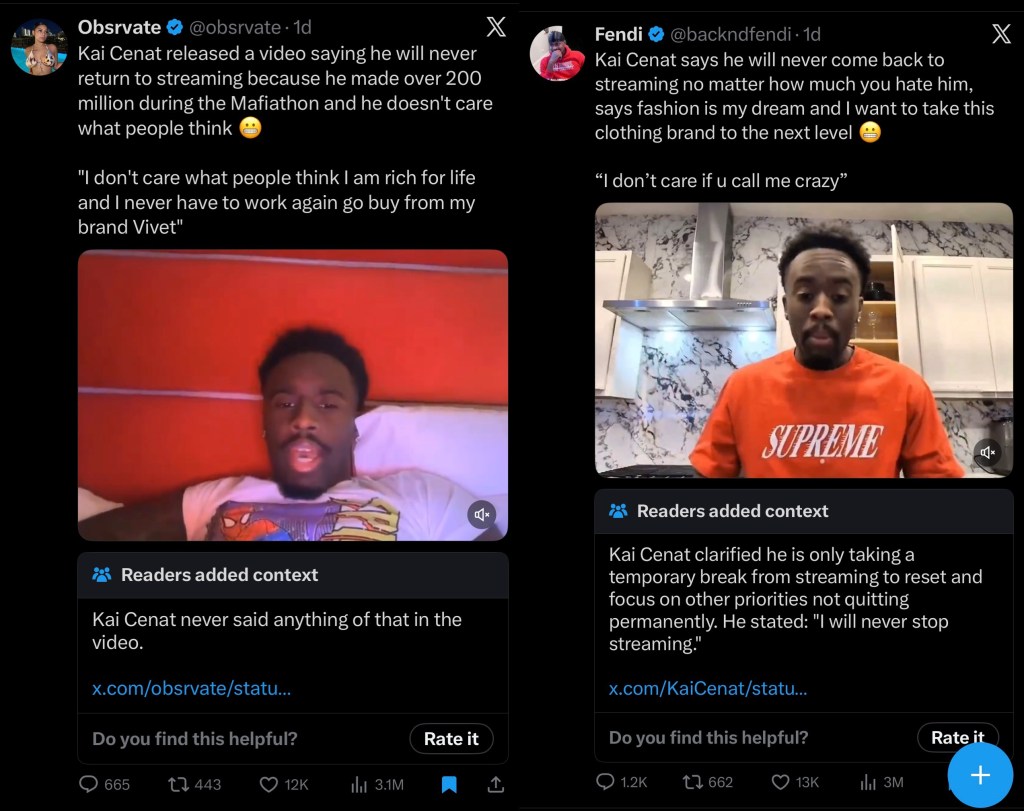
Short clips of streamer Kai Cenat recently circulated on X with the captions claiming he said he made hundreds of millions of dollars, stopped caring about fans, and was quitting streaming for good.
The problem is he never actually said those things.
Social media has fundamentally changed how information spreads. A livestream, podcast, or interview moment can now be clipped and discussed worldwide within minutes.
But while access to information has increased, the time people spend processing it has decreased. Many users are no longer watching full streams or interviews. Instead they rely on short clips reposted by aggregator accounts across platforms such as X, TikTok, and Instagram.
In many cases, the caption becomes the story.
And in an attention driven environment, captions are often written to maximize engagement rather than accuracy.
The Kai Cenat Example
The situation surrounding Kai Cenat shows how quickly a narrative can shift once a clip enters the social media ecosystem.
In the actual clips, Kai reflects on something many public figures eventually realize. He explains that worrying about internet opinion is pointless and that people should focus on pursuing their passions regardless of criticism. In another clip he encourages viewers to believe strongly in their goals even when others doubt them and that he’ll continue working on his clothing brand.
These are fairly common ideas about perseverance and ambition.
However, once the clips were reposted by streamer clip accounts, the narrative changed. Captions began claiming that Kai had made two hundred million dollars from streaming, announced that he would never stream again, and admitted that he no longer cared about fans while encouraging them to support his clothing brand.
Those statements were not present in the clips themselves.
Yet the reaction was immediate. Comment sections filled with criticism. Some accused him of using fans for money while others questioned his character and intellect. Many responses appeared to come from users who had not watched the full video.
The narrative had already taken shape.
The Business of Viral Clips
Accounts that specialize in clipping streamers operate within a system that rewards controversy. A neutral caption may generate views, but a provocative caption generates debate.
Debate produces comments, reposts, and quote tweets, all of which signal engagement to platform algorithms. Greater engagement leads to wider reach, which creates monetization opportunities through promotions, partnerships, and traffic driven advertising.
In simple terms, controversy often performs better than context.
Another tactic frequently used in this environment involves resurfacing old clips, photos, or quotes and presenting them as if they are recent. The material itself may be authentic, but removing it from its original timeline can create the impression that something controversial has just occurred.
That framing alone can trigger a new wave of reactions and engagement.
Why Context Gets Lost
Short form content has significantly reduced how long people spend engaging with individual pieces of media. What once felt normal, such as watching a five minute video, now feels like a lifetime while scrolling through constantly updating feeds.
As a result many users rely on captions, summaries, or comment sections to interpret what happened instead of verifying the original source. When several accounts repeat the same interpretation of a clip, the narrative can begin to feel factual through repetition alone.
By the time context catches up, the first version of the story has already spread.
When Engagement Becomes Strategy
This dynamic becomes even more notable when monetization and influence intersect with online narratives. Hip hop media personality DJ Akademiks recently revealed that he had once been offered money to run a negative campaign against a particular artist, which he says he declined.
Whether or not such offers become common practice, the situation highlights an important possibility. The same mechanics used for engagement farming could also be used for coordinated narrative campaigns.
The infrastructure already exists.
Where Community Notes Helps and Where It Falls Short
X has introduced tools such as Community Notes to help correct misleading posts, and in many cases the system works well by adding useful context to viral content.
The challenge is speed. Community Notes often appear only after a post has already circulated widely. By that point screenshots may have spread and many users may have already internalized the first version of the story.
Corrections rarely travel as far or as quickly as the original claim.
Possible Steps Forward
If platforms want to reduce narrative manipulation while preserving open discussion, several improvements could help.
Stronger identity verification systems could make it harder for anonymous bot networks to amplify misleading narratives. Platforms could also introduce clearer strike systems for accounts repeatedly flagged by Community Notes for misleading captions. Accounts that consistently distort context could face temporary posting restrictions or reduced visibility.
Platforms may also need clearer distinctions between satire and intentionally misleading content that harms individuals or organizations.
None of these steps would eliminate the problem entirely, but they could help create a healthier information environment.
The Real Impact
For entertainers and creators whose careers depend heavily on public perception, viral narratives can have tangible consequences. Misleading stories can influence brand partnerships, audience loyalty, and how audiences receive new projects.
In Kai Cenat’s case these clips circulated at a time when he has been focusing more attention on expanding his clothing brand. If enough people internalize a distorted narrative about him being dismissive of fans, it could shape how they respond to that brand.
All from captions that did not accurately represent the original message. In more extreme cases, sustained online vilification can also take a significant toll on the mental health of the individual at the center of the narrative.
The Cyber Layer Beneath
From a cybersecurity perspective this is more than internet drama. It demonstrates how information can be reframed and amplified within an attention driven ecosystem.
Clipping, caption framing, algorithmic amplification, and monetized engagement form a pipeline through which narratives can be created and distributed at scale.
In an environment where perception often moves faster than verification, that pipeline matters.
Because today a ten second clip can shape public perception long before the full story is ever watched.
Understanding these invisible systems is part of understanding the cyber layer beneath modern pop culture.
 Cyber in Pop Culture
Leave a comment