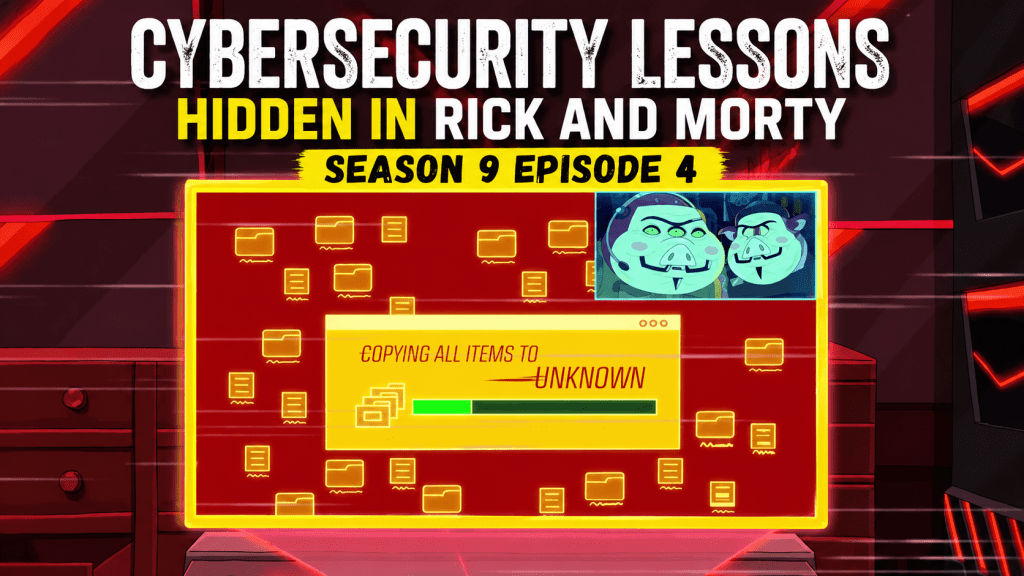
Rick and Morty Season 9 Episode 4 delivered what might be one of the show’s most cybersecurity focused episodes yet. Beneath the absurd humor and interdimensional chaos lies a surprisingly relevant story about authentication, password management, social engineering, cloud services, insider threats, ransomware tactics, and the dangers of connected technology.
The episode begins with a simple problem. Rick returns home drunk and locks himself out of his own house and garage systems. Instead of using a smartphone authenticator app or hardware token, Rick relies on Reese, a humanoid android who serves as both his multi factor authentication system and password manager.
At first glance, Reese appears to be an old friend. Morty certainly believes that. However, Reese is actually Rick’s living password vault, storing credentials and authentication capabilities that grant access to critical systems.
From a cybersecurity perspective, Reese represents a single point of failure.
If an attacker gains access to Reese, they gain access to everything.
The Human Element
Morty’s emotional attachment to Reese creates the episode’s first major security vulnerability.
When Rick decides Reese should be destroyed, Morty intervenes and saves him. His decision is driven by empathy rather than risk assessment.
Many organizations spend millions on security technology only to have those protections weakened by human decisions. Whether it is sharing credentials, ignoring policies, or trusting the wrong person, people often become the easiest path into a system.
“Hogs in Overalls Can Also Be Hackers”
One of the best lines in the episode comes when Rick reminds Morty that appearances can be deceiving.
The group of hogs who obtain Reese may not look like sophisticated threat actors, but they quickly demonstrate that hackers do not always fit stereotypes.
This reflects a valuable lesson in cybersecurity: attackers come in many forms. Threat actors are not always mysterious figures sitting in dark rooms surrounded by monitors. Sometimes they are ordinary people with enough motivation, access, and technical knowledge to exploit a weakness.
Security professionals who underestimate potential attackers often create blind spots that can later be exploited.
Credential Theft and Double Extortion
Once the hogs gain possession of Reese, they immediately begin exploiting the information stored inside him.
The first objective is gaining control of Rick’s smart home infrastructure.
The second objective is copying all of Reese’s stored data.
That detail closely resembles modern ransomware operations.
Today’s attackers rarely stop at encrypting systems. Instead, they steal sensitive data before launching their attack. This allows them to pressure victims twice:
- Pay to restore access to systems.
- Pay to prevent stolen data from being leaked.
This tactic, known as double extortion, has become one of the most common ransomware strategies in the real world.
The Smart Home Problem
After compromising Reese, the attackers take control of Rick’s highly automated house.
Furniture, appliances, and other connected devices become weapons.
While exaggerated for comedic effect, the scenario highlights a genuine concern surrounding Internet of Things (IoT) devices.
The more connected a system becomes, the larger the attack surface grows.
Rick’s futuristic home improvements serve as a reminder that convenience often comes with security tradeoffs.
Calling the Cloud Provider
To regain control, Rick contacts the team from Huge Clouds Metallurgy, the company that helped build the security infrastructure.
This mirrors a common real world incident response process. When organizations experience major security incidents, they often rely on cloud providers, managed security providers, or third party specialists to help contain and remediate the threat.
The episode takes this concept to an extreme by having a Huge Clouds representative remotely possess Jerry’s body through a phone call.
While obviously impossible, the joke resembles remote access tools that allow administrators to troubleshoot and manage systems from afar.
Fighting Back Through Infiltration
The cloud specialist eventually infiltrates the attackers and manipulates them into turning on one another.
Although dramatized, this resembles real world threat intelligence and incident response operations where defenders gather information on attackers, disrupt their activities, and reduce their ability to operate effectively.
The best cybersecurity teams do not simply block attacks. They learn how adversaries operate and use that knowledge to their advantage.
Sometimes the Simplest Solution Works
After a chaotic battle against rogue smart furniture, Rick ultimately regains control using a surprisingly familiar technique.
He cuts the power.
While cybersecurity discussions often focus on sophisticated technologies, many incident responders know that basic containment measures remain incredibly effective.
Disconnecting systems, isolating infected devices, and shutting down compromised infrastructure are often among the first steps taken during a serious incident.
Not every problem requires an advanced solution.
Sometimes you just pull the plug.
Reese and the MFA of Friendship
The episode’s climax delivers a surprisingly emotional twist.
As Reese prepares to kill Rick and Morty, their argument triggers a validation process that essentially acts like multi factor authentication for their friendship.
Instead of verifying a password or token, Reese verifies the authenticity of their relationship.
The result is that Reese “sobers up” and breaks free from the manipulation that turned him against them.
It is a funny and surprisingly heartfelt ending, but it also reinforces one of cybersecurity’s core principles:
Trust should be verified.
Whether the factor being validated is a password, a device, a biometric, or apparently a friendship, verification remains central to security.
Final Thoughts
Like many of the best episodes of Rick and Morty, this story hides serious ideas beneath ridiculous humor.
The episode touches on password management, multi factor authentication, credential theft, ransomware tactics, cloud security, IoT risks, incident response, remote access, social engineering, and human error.
Most importantly, it reminds us that threats often emerge from places we least expect. And in cybersecurity, underestimating an attacker is often the first mistake.


Leave a comment